
 Hospitals
 Companies
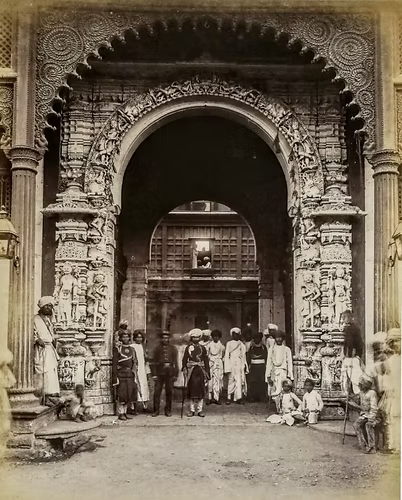 Constructed in the early 1800s by skilled local artisans, Darbargadh was commissioned during the reign of Maharaja Vijaysinhji of the Gohil dynasty. It served as the central residence for the Maharaja and his family, featuring two distinct sections: the Janana (the eastern wing for women) and the Mardana (the western wing for men). The palace was not built in a single phase but expanded gradually, reflecting the growing prosperity and influence of the Bhavnagar State.
In the late 1800s, as Bhavnagar’s economic and urban landscape rapidly evolved, Maharaja Takhatsinhji decided to relocate the primary royal residence to the Motibag Palace. Despite this shift, Darbargadh remained the symbolic heart of the kingdom.
At the height of its glory, a majestic peacock crafted from solid gold adorned the top of the palace, epitomizing the kingdom’s wealth. This prized artifact was eventually removed during the era of Maharaja Krishnakumar Singhji, when the western portion of the palace was famously leased to establish the Darbari Bank (now a branch of the State Bank of India) for a nominal sum of just one rupee.
 The eastern entrance of Darbargadh is renowned for its captivating stone carvings, which seamlessly blend Indian mythology with subtle European influences. Key features include:
- Apsaras: Depictions of these beautiful, celestial dancers adorn the gate. Symbolizing youth, elegance, and fertility, these figures echo the ethereal muses of Ancient Greece, showcasing a unique European sculptural influence on local art.
- Torans with Elephants: Traditional archways (toranas) are carved with elephants, which symbolize strength, wisdom, protection, and good fortune.
- Lord Krishna and the Cow: Carvings of Lord Krishna, the avatar of compassion, accompanied by cows, highlight the agrarian roots and prosperity of the region.
- Dvarapalas (Gate Protectors): Fierce warrior figures stand guard at the entrance. This is a classic architectural element in Hindu, Buddhist, and Jain traditions meant to ward off evil and protect the sanctity of the palace.
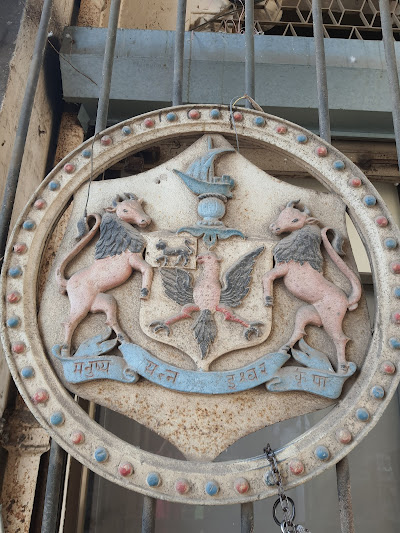
- The British Royal Emblem: Intriguingly, the top corners of the gates feature the British royal coat of arms, depicting a lion and a unicorn. This inclusion served as a permanent testament to the cordial and respectful relationship between the Bhavnagar State and the British Crown.
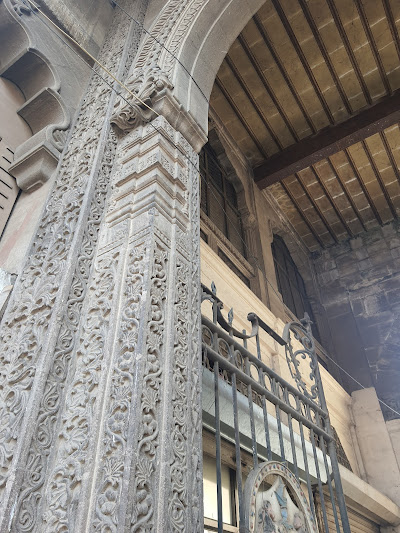
Darbargadh is a prime example of Indo-Saracenic architecture, a style that masterfully blends Indo-Islamic elements with Western and European structural design. This aesthetic was heavily championed in Bhavnagar by the state engineer, Simms, and can also be seen in local landmarks like the Nilambag Palace and Alfred High School.
The western wing, though currently bustling with modern banking activities, hides stunning architectural details. Inside the gates, visitors are greeted by majestic columns inspired by Roman villas. The first floor boasts intricate jharokhas (overhanging enclosed balconies), elongated pillars, and finely crafted jaalis (latticed screens), reflecting strong Indo-Islamic influences. The original gate, still bearing the historic Bhavnagar state emblem, stands as a proud reminder of its royal past.
Meanwhile, the eastern wing’s interior originally mirrored the older Sihor Darbargadh with its triangular staircases and ornate wooden windows. While some of these historic elements remain, other wooden structures and a central courtyard tree were removed when the eastern wing was converted into Hotel Vrindavaan following India’s independence.