
 Hospitals
 Companies
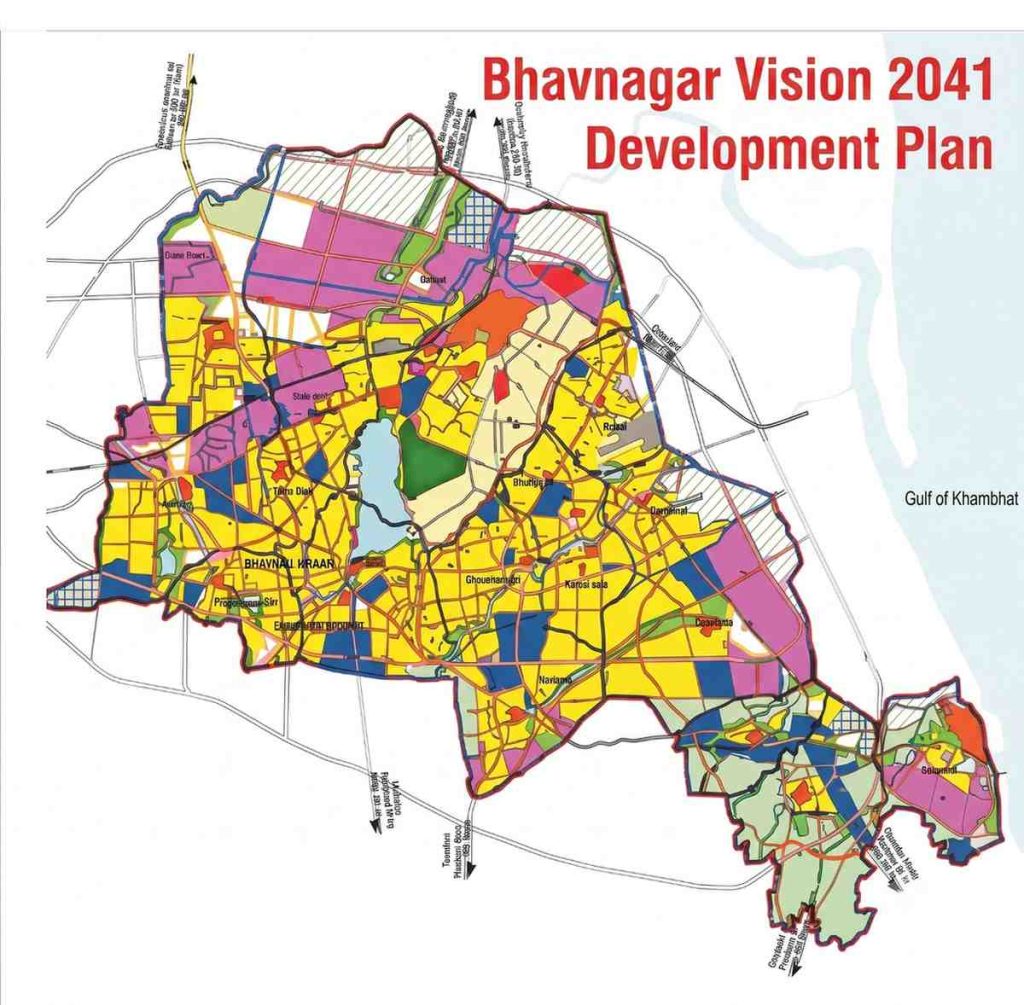
Bhavnagar is on the cusp of a major urban transformation with the Bhavnagar Development Plan 2041 (also referred to as Vision 2041 or the third revised Development Plan). Prepared by the Bhavnagar Area Development Authority (BADA), this 15 year roadmap charts the city’s growth trajectory up to 2041, focusing on expanded residential, commercial, and industrial zones, a robust ring road network, green spaces, and improved connectivity.
The plan addresses limitations of the previous Development Plan 2031 and aims to unlock development in areas beyond the current municipal limits by converting large tracts of agricultural land for urban use.
What is the Bhavnagar Development Plan 2041?
The Bhavnagar DP 2041 is the third revised Development Plan prepared under the Gujarat Town Planning and Urban Development Act. It serves as the statutory master plan guiding land use, zoning, infrastructure, and urban expansion for Bhavnagar and its surrounding areas.
BADA prepared the plan over approximately four years through consultations with industrialists, builders, chambers of commerce, and villagers. It was submitted to the government and published in the Gazette on 3 March 2026 under Section 13(1). A 60-day public objection and suggestion period followed, ending on 3 May 2026.
The official proposed land use map and index map for the Bhavnagar Development Plan 2041 are hosted on the Bhavnagar Municipal Corporation (BMC) website for public reference.
Why Was a New Development Plan Needed?
The previous DP 2031 (published in 2011) faced implementation challenges, including slow progress on key projects like the 45 meter ring road and development in areas such as Madhiya GIDC. Rapid urbanization, population growth, and the need to expand beyond traditional municipal boundaries necessitated a comprehensive revision.
The new plan focuses on:
- Large-scale rezoning of agricultural land for residential and other uses.
- Strengthening regional connectivity through a multi-tier ring road system.
- Balancing development with environmental considerations (water bodies, urban forests).
- Creating dedicated spaces for logistics, sports, conventions, and industry.
Key Land Use Proposals in Bhavnagar Vision 2041
One of the most significant aspects of the Bhavnagar Development Plan 2041 is the proposed conversion of agricultural land to urban zones:
- 9,802 hectares of agricultural land → Residential zones Villages covered: Vartej, Faryadka, Shampara, Sidsar, Avaniya, Malanka, Akvada, and Budhel. This marks the first major proposal of this scale to bypass the previous 5% construction restriction in agricultural zones.
- 1,467 hectares → Commercial zones
- 3,156 hectares → Industrial zones (including areas in Ghoghha and Avaniya)
Additionally:
- 897 hectares reserved for water bodies and natural drains.
- 181 hectares earmarked for urban forests (on the second bank of the Bortala river and in the Nari area), inspired by Victoria Park.
- 33 hectares reserved for a convention center (as per BMC demand).
- A logistic park (modeled on the Sanand model) proposed in the transport and communication zone.
Ring Road Network: The Backbone of Bhavnagar’s Future Connectivity
A major highlight of the Bhavnagar DP 2041 is the planned multi-phase ring road system:
- Existing/Under Construction: 45 meter ring road.
- Proposed 75-meter ring road: Expected to begin construction in the next 6–7 years.
- Proposed 90-meter ring road: Likely to start after 10 years.
All major zones will be connected to these ring roads through 24 to 60 meter wide four-lane roads. This hierarchical road network aims to improve traffic flow, reduce congestion in the core city, and better integrate surrounding villages and industrial areas.
Quote from BADA Chairman Dr. N.K. Meena (as reported in contemporary coverage): “75-meter ring road in the next 6 to 7 years, and 90-meter ring road’s work likely to start after 10 years.”
Sports, Public Amenities & Green Infrastructure
The plan makes notable adjustments to sports and public facilities:
- Cricket Stadium: Reduced from 86 hectares in DP 2031 to 50 hectares in Ruva (due to land occupation by Gujarat Maritime Board in the Darbari Bhatha area). An additional 50 hectares has been reserved in the Nari area for another stadium planned by the corporation.
- Urban Forest: 181 hectares dedicated to green lungs.
- Convention Center: 33 hectares to support events, conferences, and tourism potential.
These elements aim to enhance Bhavnagar’s livability, recreational options, and capacity to host larger events.
Town Planning Schemes (TP Schemes) Under the New Plan
The Bhavnagar Development Plan 2041 incorporates 31 Town Planning Schemes:
- 13 final TP schemes
- 18 draft TP schemes
These schemes help in detailed micro-level planning, land pooling, and infrastructure development within specific pockets.
Current Status (as of July 2026)
As of early July 2026, the public objection period for the Bhavnagar DP 2041 (published March 2026) has concluded. The plan is now in the process of final review and approval by the state government. Citizens and stakeholders can still access the official documents and maps for reference.
Official Resources:
- Bhavnagar DP 2041 Proposed Land Use Map (Section-13(1)): Available on the BMC website.
- Previous DP 2031 document also hosted for comparison.
For the latest updates or to inquire about specific plots/zones, contact Bhavnagar Area Development Authority (BADA):
- Address: BADA Building, Near Income Tax Office, Motibag Townhall, Bhavnagar – 364001
- Phone: 0278-2516252
Potential Impact of Bhavnagar Development Plan 2041
For Real Estate & Housing:
The conversion of nearly 9,802 hectares of agricultural land into residential zones is expected to significantly expand housing supply and open new areas for plotted developments and townships in villages around Bhavnagar.
For Industry & Economy:
Dedicated industrial zones in Ghoghha and Avaniya, along with a proposed logistic park, position Bhavnagar as a stronger logistics and manufacturing hub in the Saurashtra region.
For Connectivity & Mobility:
The phased ring road network will improve regional connectivity, reduce travel time, and support smoother movement of goods and people.
For Environment & Livability:
Provisions for urban forests, water body protection, and better-planned drainage aim to create a more sustainable urban environment.
For Tourism & Events:
New convention center and sports infrastructure can boost MICE (Meetings, Incentives, Conferences, Exhibitions) tourism and sports-related activities.
Challenges Noted in the Plan
Certain areas, particularly Madhiya and Nari, face monsoon water accumulation issues that may require additional engineering solutions during implementation.
Frequently Asked Questions (FAQ)
What is Bhavnagar Development Plan 2041?
It is the third revised master plan prepared by BADA that guides land use, zoning, infrastructure, and urban growth of Bhavnagar up to 2041.
When was the Bhavnagar DP 2041 published?
It was published in the Gazette on 3 March 2026, followed by a 60-day public consultation period.
What are the major ring roads proposed?
A 45-meter ring road (existing/under construction), a new 75-meter ring road (6–7 years), and a 90-meter ring road (after 10 years).
Which villages will see major residential development?
Vartej, Faryadka, Shampara, Sidsar, Avaniya, Malanka, Akvada, and Budhel (among others) through large-scale agricultural-to-residential conversion.
Where can I see the official maps?
Official proposed land use maps are available on the BMC website under the DP Map section.
Conclusion: A Defining Chapter for Bhavnagar’s Future
The Bhavnagar Development Plan 2041 represents one of the most ambitious urban planning exercises for the city in recent decades. With its focus on expanded zoning, multi-tier ring roads, green spaces, and supporting infrastructure, it lays the foundation for sustainable and inclusive growth.
While the plan has completed its public consultation phase, its successful implementation will depend on coordinated efforts between BADA, Bhavnagar Municipal Corporation, state government departments, and active citizen participation.
For residents, investors, real estate developers, and businesses, staying updated with official notifications from BADA and BMC will be essential as the city moves toward its 2041 vision.

Dhiraj Patel is a seasoned writer for Bhavnagar.city, passionately exploring the city’s culture, history, and lifestyle. With a deep understanding of Bhavnagar’s heritage, he crafts engaging, well-researched content that resonates with locals and visitors alike. Dhiraj’s expertise and firsthand experiences ensure his articles are both informative and trustworthy.